
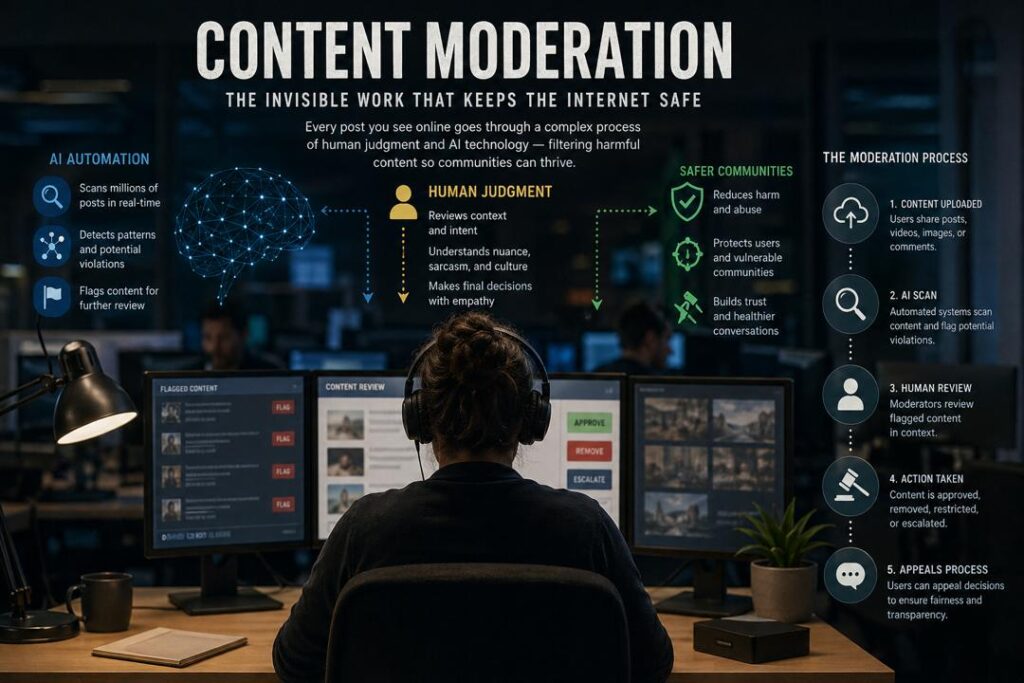
Due to the rise of social media, the internet and the mass digitalization of entertainment, work and social interaction, content has increasingly become a currency, a tool of communication and a means of connection. However, just as every other modern creation, abuse is inevitable. While content has been of great and positive impact, it has also been a victim of misappropriation and a tool for vulgarity, cyber bullying, hate speech and other digital vices. In the light of this, more and more regulations and restrictions are being put in place to ensure online safety and virtual decency. This is where content moderation comes in and we will be breaking down everything that content moderation does.
WHAT IS CONTENT MODERATION?
Content moderation is the process of monitoring, reviewing, and managing user-generated content on digital platforms to ensure it complies with community guidelines, legal standards, and platform policies. It’s what keeps platforms like Facebook, TikTok, YouTube, and X usable, safe, and legally compliant.
At its core, content moderation sits at the intersection of technology, law, ethics, and human judgment. It is a method of checkmating all forms of content on the internet to ensure decorum on digital platforms and online spaces.
WHY IT EXISTS
Every day, more and more people are increasingly at risk of digital violations like harassment, violation and exploitation and as such, individuals, businesses and governments are putting laws and actions in place to ensure the protection of the rights of people. Content moderation exists for certain reasons, some of which will be elaborated below.
Prevent harm : Firstly, it exists to prevent potential harm from occurring. While online vices already exist through content, moderation is essential for preemptive detection and restriction. This reduces the amount of people it can reach and affect.
Protection of users : It also exists to protect users and vulnerable groups from experiencing abuse and violations. To ensure that the online space is conducive for people in various groups (women, children, people living with disabilities etc), moderating content is non-negotiable.
Regulations and Legal compliance: Also, digital platforms aren’t operating in a vacuum. Governments across the world impose rules around what can and cannot be published—especially when it comes to terrorism, child exploitation, and copyright infringement.
Platforms like YouTube are legally required to remove certain types of content, sometimes within strict timeframes. Failure to do so can result in fines, restrictions, or even bans in specific countries.
In this sense, moderation isn’t optional, it’s part of staying in business.
Maintaining Platform Integrity : User trust is fragile. If a platform becomes known for toxicity, misinformation, or graphic content, people leave, or at the very least, engage less.
Moderation helps maintain a baseline level of quality and civility. It shapes the tone of conversations, the kind of content that thrives, and ultimately, the kind of community that forms.
Protecting Revenue and Brand Relationships: There’s also a commercial reality. Advertisers don’t want their brands appearing next to extremist content, scams, or explicit material. If moderation fails, revenue follows.
This has pushed companies like X to invest heavily in brand safety tools and stricter enforcement policies, sometimes sparking debates about overreach.
In a nutshell, content moderation exists because the internet is not neutral. It has to be actively shaped, filtered, and managed to remain usable, lawful, and profitable.
READ MORE: HOW CONTENT MODERATION WORKS
TYPES OF CONTENT MODERATION
There are various methods in which content can be moderated, from humans to artificial intelligence and even a combination of both. Each method has been proven effective, having their own pros and cons and in this segment, we will be breaking down the various types of content moderation.
Human Moderation:
Behind every major platform is a workforce tasked with reviewing content that machines can’t confidently interpret.
Human moderators step in when context matters, when a joke could be mistaken for hate speech, or when cultural nuance changes the meaning of a post entirely. They make judgment calls that require context, empathy, experience, and sometimes instinct. A clear example of this is the “Community Notes” feature that was recently added to X (formerly Twitter) where users can add clarifications to narratives and
But this comes at a cost. The work is repetitive, high-pressure, and often emotionally draining. Moderators are frequently exposed to disturbing material, from graphic violence to exploitation. Despite this, their role remains largely invisible to the public.
Automated Moderation:
To handle the sheer volume of content uploaded every second, platforms rely heavily on automation.
Machine learning systems scan text, images, and videos in real time, flagging keywords, detecting patterns, and sometimes removing content instantly. On platforms like YouTube, this can mean identifying copyrighted material within seconds of upload.
Automation brings speed and scale, but it lacks subtlety. Algorithms can misread satire, miss coded language, or unfairly target certain groups due to biased training data.
Hybrid Moderation:
Most platforms have settled on a hybrid model because they have to. It’s easier and more efficient to get more done with this method because it combines the speed and effectiveness of technology and the instinct of judgement of humans, leading to more objective results.
AI handles the bulk work: scanning, flagging, filtering. Human moderators handle the edge cases: reviewing appeals, interpreting context, and making final decisions where nuance matters.
It’s not a perfect system, but it’s the most practical one available. At scale, moderation becomes less about perfection and more about managing trade-offs, speed vs accuracy, safety vs freedom, automation vs human judgment.
CONCLUSION
Content moderation is easy to overlook precisely because it works. The cleaner the internet feels, the less you notice the systems and people making it that way. But behind every removed post, flagged video, or suspended account is a series of decisions shaping what billions of people see, say, and believe online.
As platforms continue to grow, so does the power of moderation. It doesn’t just protect users, it quietly defines the boundaries of digital expression. And that raises an important question: in a world increasingly lived online, who gets to decide what stays visible, and what disappears?
In our subsequent blogs, we would explain more about how content moderation works and the opportunities it presents to people in this day and age.