
In the previous part, we explored what content moderation is, why it exists, and the different forms it takes. However, understanding the concept alone is not enough. To fully grasp its impact, it is important to look at how content moderation actually works behind the scenes and what this means for individuals, businesses, and the broader digital economy.
While moderation may appear simple on the surface, the reality is far more complex. Every post, comment, image, or video goes through a structured system designed to evaluate, filter, and decide whether that content should remain visible or not. This system operates at a scale that most users never fully appreciate.
HOW CONTENT MODERATION WORKS
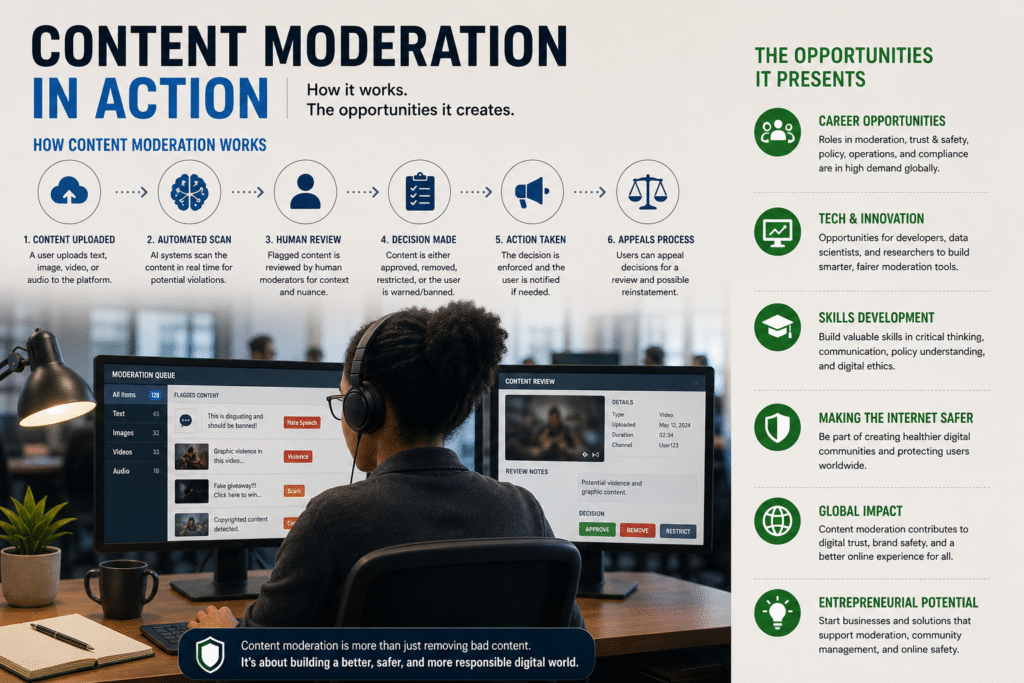
The process of content moderation begins the moment content is created and uploaded onto a platform. Whether it is a tweet, a video, or a comment, it enters a digital pipeline where it is immediately assessed using a combination of automated systems and human oversight.
The first layer of this process is automated scanning. Once content is uploaded, artificial intelligence systems begin analyzing it in real time. These systems are trained to detect specific signals such as harmful keywords, suspicious patterns, nudity, violence, or copyrighted material. In many cases, decisions are made almost instantly. Content that clearly violates platform rules may be removed immediately, while other content is flagged for further review.
However, automation alone is not sufficient. This is where the second layer comes in, which is human review. Content that falls into a grey area is sent to human moderators who evaluate it more carefully. Unlike machines, humans can understand tone, context, and cultural nuance. They can distinguish between satire and hate speech, or between a harmful statement and a harmless joke. This layer is essential because not all violations are obvious, and not all content can be judged by patterns alone.
Once content has been reviewed, a decision is made. This decision can take several forms. The content may be approved and allowed to remain online. It may be removed entirely if it violates guidelines. In some cases, its visibility may be reduced, meaning fewer people will see it. Platforms may also issue warnings, temporarily restrict accounts, or permanently ban users depending on the severity of the violation.
Another important aspect of this process is the appeals system. Users are often given the opportunity to challenge moderation decisions. This adds a layer of accountability and ensures that errors can be corrected. It also highlights an important truth about content moderation, which is that it is not always perfect. Mistakes happen, and systems must be designed to handle them.
At its core, content moderation is not a single action but a continuous cycle. Content is created, evaluated, acted upon, and sometimes re-evaluated. As new types of content emerge and user behavior evolves, moderation systems must also adapt. This makes it a constantly evolving process rather than a fixed system.
THE ROLE OF DATA AND TECHNOLOGY
Behind this process lies a vast amount of data. Every decision made by a moderation system contributes to improving future decisions. Machine learning models are trained using large datasets that help them recognize patterns and predict potential violations. Over time, these systems become more efficient, although they are still limited by the quality of the data they are trained on.
Technology also enables scalability. Without automated systems, it would be impossible to moderate the sheer volume of content uploaded every second. However, this reliance on technology also introduces challenges such as bias, errors, and lack of contextual understanding. This is why human involvement remains critical despite advances in artificial intelligence.
THE OPPORTUNITIES CONTENT MODERATION PRESENTS
Beyond its role in maintaining online safety, content moderation has also created a range of opportunities across different fields. As digital platforms continue to expand, the demand for moderation systems and professionals continues to grow.
One of the most direct opportunities is employment. Content moderation has become a major source of jobs globally, with companies hiring individuals to review and manage content across platforms. These roles are not limited to large tech companies alone. Outsourcing firms, startups, and even local businesses now require moderation services to manage their online presence.
In addition to moderation roles, there is a growing demand for professionals in related fields such as policy development, trust and safety management, and compliance. These roles involve creating the rules that moderators enforce, ensuring that platforms align with legal requirements, and improving the overall effectiveness of moderation systems.
Technology also presents significant opportunities. Developers and data scientists are needed to build and improve automated moderation systems. This includes designing algorithms, training machine learning models, and addressing issues such as bias and accuracy. As platforms continue to rely on artificial intelligence, the demand for technical expertise in this area will only increase.
Another important opportunity lies in digital entrepreneurship. Businesses that operate online must now consider content moderation as part of their strategy. Whether it is managing user comments, filtering spam, or protecting brand reputation, moderation has become a necessary function for digital growth. This has opened up opportunities for agencies and freelancers who specialize in managing online communities and ensuring safe digital environments.
Content moderation also plays a role in shaping digital literacy and awareness. As more people understand how content is filtered and managed, they become more conscious of what they post and consume. This creates opportunities for educators, writers, and communicators to explore topics around digital responsibility, misinformation, and online ethics.
READ MORE: WHAT IS CONTENT MODERATION?
THE BIGGER PICTURE
What becomes clear is that content moderation is not just a background process. It is a system that influences how information flows, how communities interact, and how digital spaces evolve. It affects everything from individual user experiences to global conversations.
At the same time, it is an area that continues to grow in complexity. As new technologies emerge and online behavior changes, moderation systems must keep up. This creates both challenges and opportunities for innovation, employment, and policy development.
Understanding how content moderation works provides a clearer picture of the internet itself. It reveals that the online world is not as open or unfiltered as it may seem. Instead, it is carefully structured and continuously managed.
CONCLUSION
Content moderation is more than just a tool for maintaining order. It is a system that powers the modern digital experience while creating opportunities for those who understand it.
As the internet continues to expand, the need for effective moderation will only increase. And with that growth comes the chance for individuals and businesses to participate in shaping safer, more responsible online spaces.
The question is no longer whether content moderation matters. It is how we choose to engage with it, improve it, and build around it in the years to come.