

Remote work is often characterized by the luxury and flexibility of time it provides. The ability to work at your own pace and time (for certain roles) and the opportunity to plan your time according to how it benefits you as opposed to the strict working hours 9-5’s present. It seems like you are in control of your time, and maybe you are.
However, it is very common to fall into the illusion of time and get stuck with several incomplete tasks and approaching deadlines if you don’t follow these steps below.
This article will help you with strategies that enable you to maximize your time and get things done fast and efficiently without having to struggle with too many deadlines and improve your overall productivity.
UNDERSTAND YOUR PEAK PRODUCTIVITY HOURS
Everyone has different energy patterns during the day. There are periods when you have a long energy boost and it is important that you capitalize on these patterns. The first step is to recognize these patterns. Do you feel more energized and productive during the early hours of the day or do you prefer working at night? Discovering this changes everything.
After that, one major hack is to schedule your most demanding tasks during your peak performance periods. This will enable you to make use of your most productive hours for your difficult tasks, helping you get more work done while you’re at your flow state. Other administrative tasks like scheduling or responding to emails and routine tasks can be carried out when you’re done with the heavier ones. Also, if you live in an area that has a pattern of power supply (e.g having better power supply in the morning or at night), planning and making adjustments around this is highly important and can greatly contribute to your overall output.
THE TIME BLOCKING METHOD
This involves assigning specific time blocks to specific tasks or types of work. Here, you treat these blocks like unmovable appointments that have to be completed within the designated time allotted
How to implement it:
- Block your calendar for deep work sessions (2-3 hour chunks)
- Block time for emails and communication (rather than checking constantly)
- Block time for meetings and calls
- Block buffer time between tasks for breaks and transitions
- Use color coding to visualize different types of work
USE A POMODORO TECHNIQUE
Here, work is split into batches. A task can be assigned for 25,30 or 60 minutes, then take a 5-10 minute break. Repeat this several times in a day and you’d complete lots of tasks and get into a deep focus mode.
This technique aids you in focusing for extended periods of time before getting burnt out from work. It also helps you complete tasks in each pomodoro session (e.g first hour could be focused on responding to emails and the second could be for scheduling meetings).
A simple way to achieve this without any third party apps is to set a timer with your default phone timer. You get more work done as this technique has been tried, tested and proven to be efficient.
BATCHING SIMILAR TASKS
This involves grouping similar tasks together and doing them in one session. If tasks are similar, doing them together helps you complete all those tasks at once , enabling you save more time and get more work done. It also reduces context switching and setup time. Some of these tasks include responding to all emails at set times (morning, midday, end of day), recording all video updates or content at once, making all calls back-to-back, processing invoices or admin work, social media scheduling for the week
To effectively implement this, it is important that you designate specific days or times for batched tasks and communicate batch times to the team (e.g., “I check Slack at 10am, 2pm, and 5pm”). This would create a proper structure and reduce excessive work for you.
THE EISONHOWER MATRIX
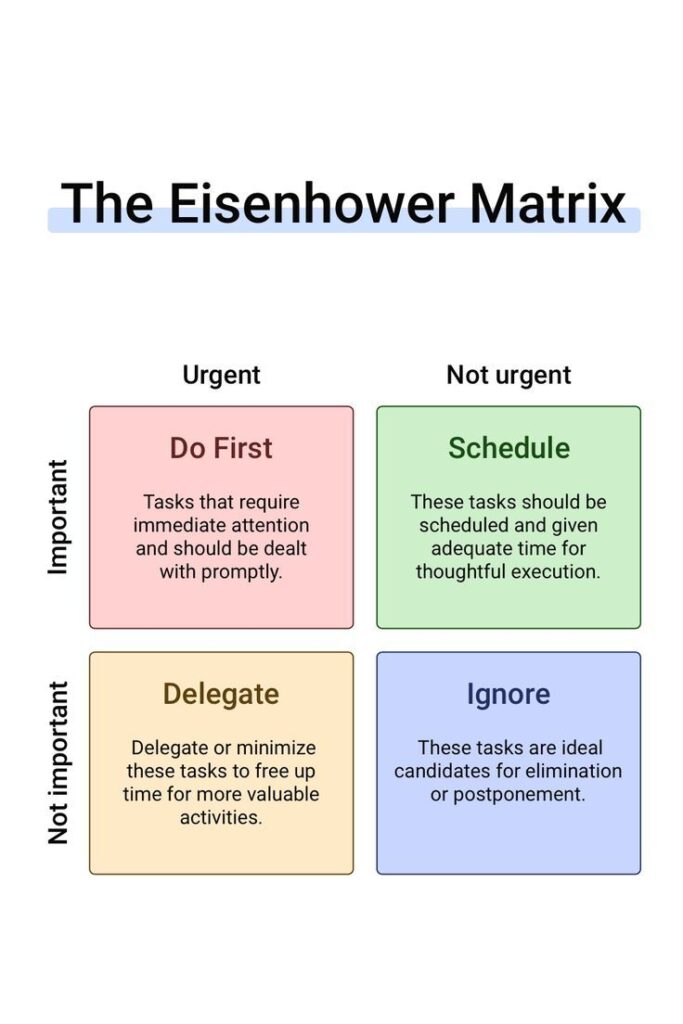
The Eisenhower Matrix helps you prioritize tasks by sorting them into four categories: urgent and important, important but not urgent, urgent but not important, and neither urgent nor important. For remote workers juggling multiple clients and projects, this simple framework prevents the trap of spending entire days on tasks that feel urgent but don’t actually move work forward. Urgent and important tasks like a client deadline today get done immediately. Important but not urgent tasks like learning a new skill or improving systems get scheduled for specific times. Urgent but not important tasks like most emails can be batched or delegated. Tasks that are neither urgent nor important, like excessive social media checking or unnecessary meetings, should be eliminated entirely. Using this matrix at the start of each day or week helps remote workers focus energy on what truly matters rather than constantly reacting to whatever feels most pressing in the moment. The result is better work output, less stress, and more control over how time is actually spent.
THE TWO MINUTE RULE
This rule simply states that if a task takes two minutes or less to do, make sure you do it immediately. These tasks are not to be scheduled or kept for later or to be scheduled with other major tasks. This helps eliminate the smaller tasks which may sometimes be urgent. These types of tasks include replying to a quick email filing a document, sending a short message to a client, updating a task status. This would help you prevent small tasks from piling up, reduces mental clutter, creates momentum and helps you get work done.
ALWAYS START IMMEDIATELY
When a task is assigned, it is easy to think there’s time, especially when the deadline is far away. What most people fail to realize is that the more time you take to start a task the less time you have to complete it. For example, a virtual assistant who has 5 meetings to schedule, dozens of emails to respond to and a flight itinerary to book will face significant challenges if they do not start on time. Starting a task on time is one of the most effective time management techniques, ensuring every assigned task is completed in due time.
Time management strategies don’t just involve cramming many things into your day. It begins with understanding what techniques work best for you according to your energy patterns. Adopting these strategies might take a while to get used to. Start with about 2-3 methods, not all of them. Experiment to find what works for you based on your role, personality and context. Remember, the goal is to maximize your time and get your job done, not to get burnt out. Stay disciplined and stay consistent and these strategies will yield positive results.